Loading...
Specifications
Figures below are typical values from batch QC; a Certificate of Analysis with measured values accompanies every shipment.
| PROPERTY | VALUE · METHOD |
|---|---|
| Base | highly refined mineral oil, anticorrosion additives, antioxidants |
| Protection term | 12 months / application |
| Barrier film | elastic, penetrates under rust |
| Free of | silicone, PTFE, acrylic, solvents |
| Application | −20…+35 °C · sets in 15 min |
| Service temperature | −80…+250 °C |
| Shelf life | 5 years, sealed |
MECHANISM
Three things happen on the metal.
01 — DISPLACEMENT
Low surface tension lets the fluid creep under moisture films and electrolyte residues, lifting them off the substrate — including inside seams and threads.
02 — PENETRATION
It creeps into microscopic recesses, threads and seams — and under existing rust, loosening its grip and stopping the corrosion beneath.
03 — FILM BUILD
What remains is an elastic protective layer with strong lubricating properties — seized parts regain mobility, sealed for 12 months.
Format & pricing
Priced per tote, EXW Tallinn, by quote. DAP / FCA quoted per lane on the wholesale program.
1,000 L IBC TOTE — THE ONLY FORMAT
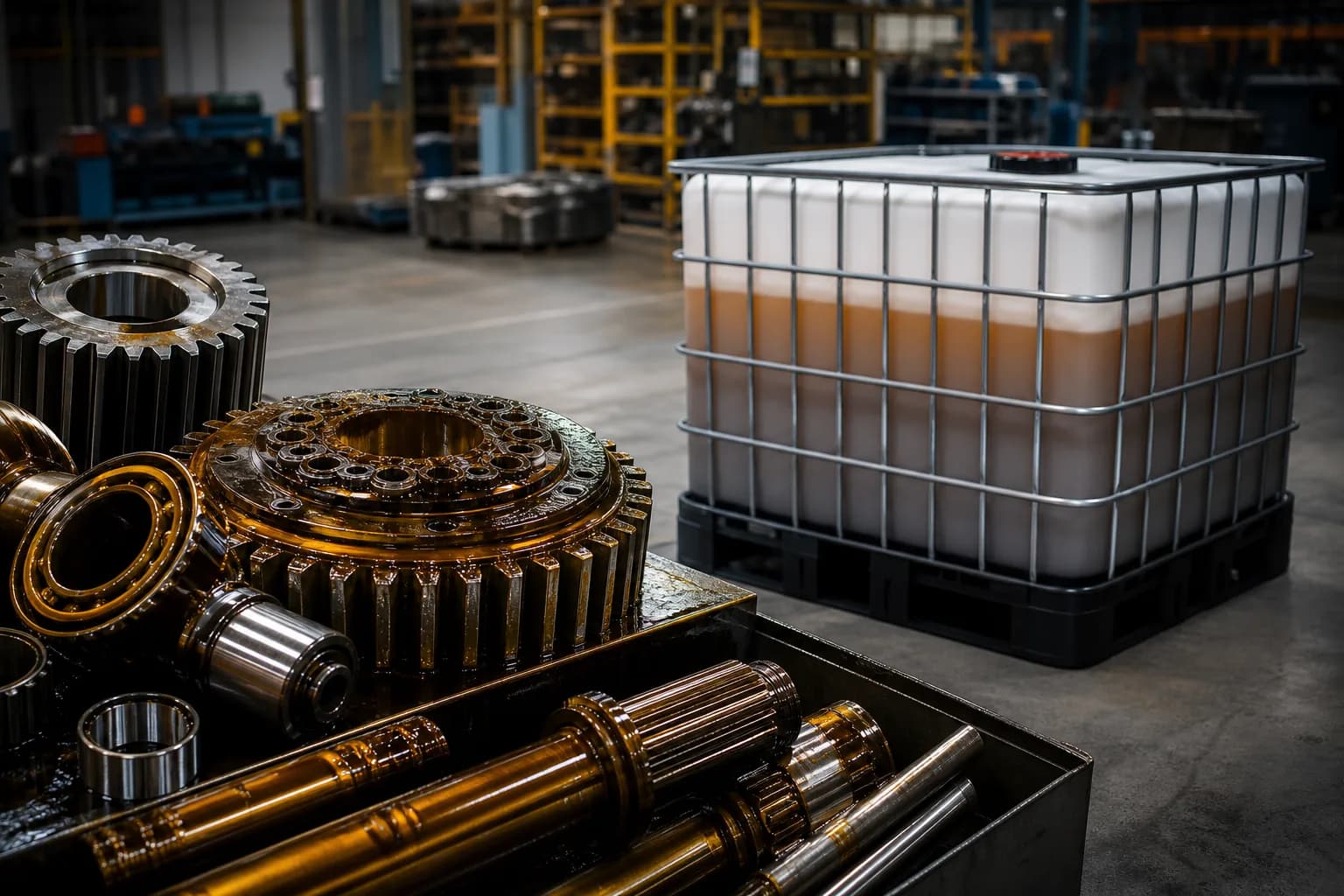
UN-certified composite IBC on CP3 pallet, DN50 bottom valve. Filled, sealed and batch-certified in Tallinn; evaluation sample with any quote.
by quote
TOTE-COUNT TIERS
1 TOTEBY QUOTE
2–4 TOTESBY QUOTE
5–9 TOTESBY QUOTE
10+ / ANNUALNEGOTIATED
A corrosion inhibitor engineered for bulk application
Our anticorrosion formulation is a moisture-displacing corrosion inhibitor supplied as ready-to-use raw material in IBC totes (1,000 L) and drums. It forms a thin, elastic protective film that seals metal against moisture and salt attack — the two drivers of electrochemical corrosion.
What the formulation does
The film stops active corrosion on contact and prevents new oxidation for at least 12 months per application under normal exposure. Unlike hard coatings, it never dries, cracks or flakes: the film stays elastic, self-heals around scratches, and requires no surface pre-treatment beyond loose-rust removal.
It is harmless to metals, plastics, rubber, paint and lacquered surfaces, which makes it suitable for treating assembled equipment — fasteners, hinges, cable glands, machined faces — without masking.
Composition
A mineral-oil system: 65% high-purity mineral oil, 5% anticorrosion additives, 5% antioxidants, 25% paraffin and naphthene hydrocarbons. A synthetic-oil variant is available for low-temperature applications. No acids, no silicones, no resins.
Typical bulk applications
Off-season preservation of machinery and agricultural equipment, transport underbody and chassis protection, marine and coastal equipment, tooling storage, export packaging of metal goods, and private-label filling of retail anticorrosion products.
Where the formulation fits in your process
As a rust inhibitor supplied at raw-material scale, the formulation slots into three workflows. Preservation: parts and assemblies treated before storage or export packing emerge service-ready months later — no de-greasing of hard waxes, no re-work. Maintenance: fleets, vessels and plants treat underbodies, fasteners, hinge points and cut edges on a seasonal calendar, applied by airless spray, dip or fogging with standard equipment. Manufacturing: inter-operation protection for machined surfaces that would otherwise flash-rust between process steps.
Mixed metals, coastal service and the hard cases
The film is chemically neutral to steel, stainless, aluminium, copper and zinc coatings, which makes it a single answer for mixed-metal assemblies where galvanic corrosion starts at every dissimilar-metal joint. It denies the electrolyte path the cell needs, and it stops the white, fastener-seizing bloom of aluminum corrosion around stainless bolts. In chloride-heavy coastal service — where pitting defeats passive layers and undercuts paint at every chip — the displacement action lifts the salt-bearing water film off the metal before sealing it.
What you can verify before you buy
Every claim above is testable at sample scale. The laboratory sample ships with our test protocols: treat panels of your own steel and aluminium, expose them at your site, and score red-rust onset against your current product. Salt-spray endurance is documented per ISO 9227 test reports, film behaviour at scribe lines included. When the sample passes, a 200 L pilot drum proves the application process at line scale before the first tote. Documentation follows every batch — certificate of analysis, SDS, published composition and REACH conformity — in the language your quality system needs.
For procurement teams comparing suppliers: request the salt-spray report, the coverage-per-litre figure at stated film thickness, and the compatibility block for your metals and elastomers. Then put the numbers to the panel test. The formulation competes on documented performance per litre — not on brand, packaging or adjectives — and the evaluation path from sample to pilot to tote is designed so that every scale-up step is approved on your own data.
USE CASES
Where the amber line earns its keep.
Six patterns cover most of our order book. If yours isn't here, the rust-prevention guide maps the wider territory.
✓Export packing — parts sealed for 6–12 month sea freight
✓Fleet underbody & cavity preservation at depot scale
✓Offshore fasteners, flanges and winch gear in salt fog
✓Tooling, dies and spares in unheated storage
✓Agricultural implements between seasons
✓Private-label brands — our totes, your filling line
Corrosion inhibitor FAQ
Inhibitor, coating or oil — which is this?+
All three, functionally: an oil-phase carrier delivers adsorption inhibitors and leaves a thin waxy coating. It sits between a preservation oil and a hard anticorrosion paint — protective like a coating, removable like an oil.
Can parts be painted or welded afterwards?+
The film removes with an alkaline wash or solvent wipe; after degreasing, surfaces paint and weld normally. For overcoat-without-removal systems, ask the lab for the paintable variant on a pilot batch.
Is it safe on elastomers and painted surfaces?+
Neutral toward common elastomers (NBR, EPDM) and cured industrial paints at service temperatures. Compatibility protocols for your specific materials are part of the lab-sample documentation.
How does it differ from the dielectric line?+
This line maximizes barrier durability on structural metal. The dielectric lubricant maximizes insulation performance on live electrical equipment — optimized for insulation on live equipment, without conductive fillers.
Keep reading
LINE 02 · PRODUCT
Dielectric lubricant
The electrical counterpart — insulate contacts and panels the way this line seals structure.
GUIDE
Rust prevention, in depth
Coatings vs inhibitors vs oils — how to choose per exposure class and budget.
FIELD NOTES
Removing rust that's already there
Six removal methods compared — then how to keep it from coming back.
Validate it on your parts first.
Lab samples ship within a week — sealed bottle, CoA and test protocols included.