Loading...
Specifications
Typical batch QC values; measured figures ship on the Certificate of Analysis with every order.
| PROPERTY | VALUE · METHOD |
|---|---|
| Base | highly refined mineral oil, additives, antioxidants |
| Prevents | short circuits and leakage currents |
| Restores | insulation resistance of damp equipment |
| Moisture displacement | all forms — vapour, condensate, fog, rain |
| Service temperature | −80…+250 °C |
| Film | non-curing, re-enterable |
| Plastics & elastomers | safe on metals, plastics, rubber, glass, ceramics |
| Protection / shelf life | 12 months · 5 years sealed |
MECHANISM
Why wet electronics come back to life.
01 — DISPLACEMENT
The fluid undercuts water films on contacts and windings and floats them off — insulation resistance recovers within minutes of application.
02 — INSULATION
The dielectric film raises insulation resistance, suppressing short circuits, leakage currents and oxidation on closely spaced conductors.
03 — PRESERVATION
The same film seals contacts against condensation cycles, fungus and mould — 12 months per application — without ever curing solid.
Format & pricing
Priced per tote, EXW Tallinn, by quote. DAP / FCA quoted per lane on the wholesale program.
1,000 L IBC TOTE — THE ONLY FORMAT
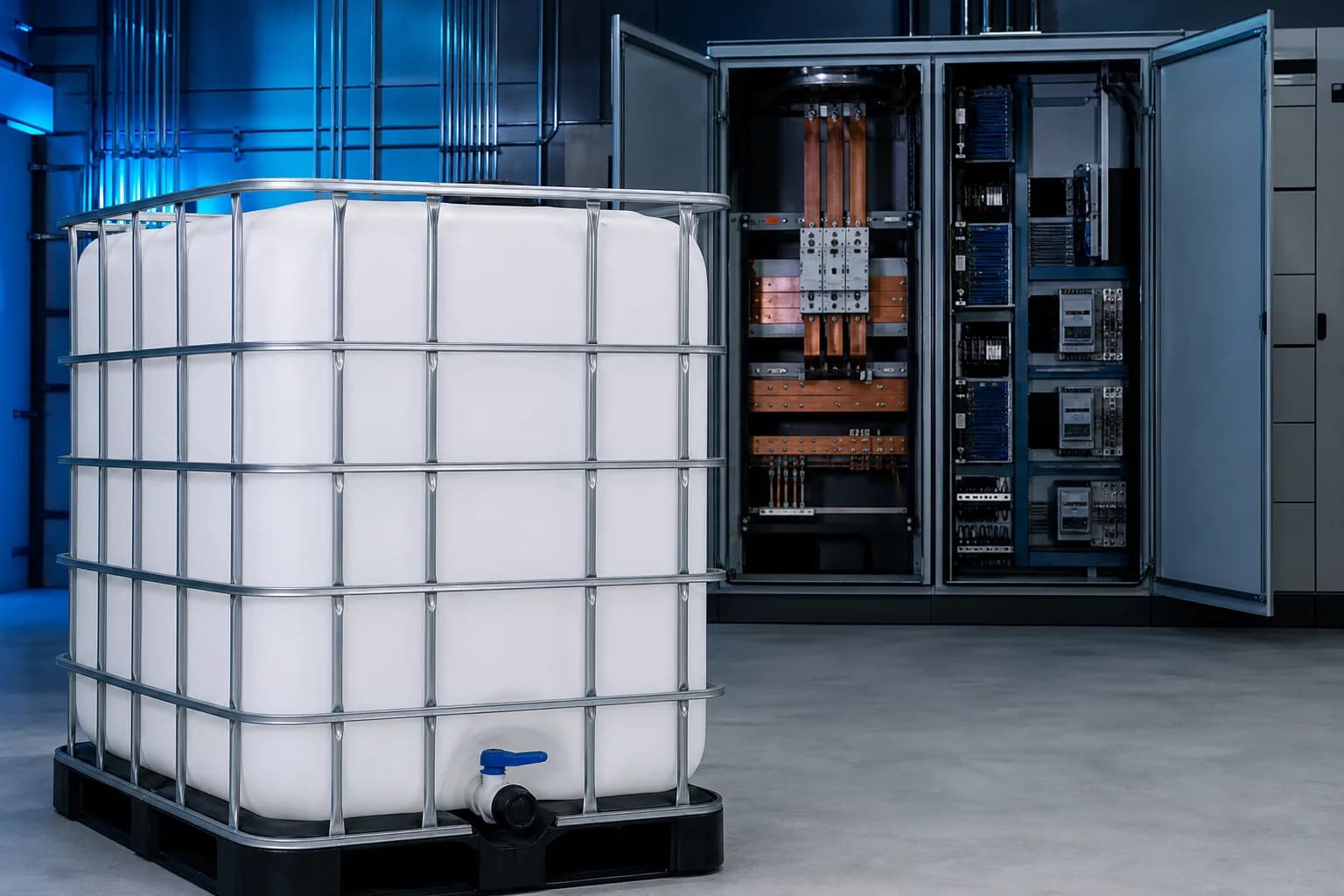
UN-certified composite IBC on CP3 pallet, DN50 bottom valve. Filled, sealed and batch-certified in Tallinn; evaluation sample with any quote.
by quote
TOTE-COUNT TIERS
1 TOTEBY QUOTE
2–4 TOTESBY QUOTE
5–9 TOTESBY QUOTE
10+ / ANNUALNEGOTIATED
Moisture protection for electrics, by the tote
Our dielectric formulation is an insulating lubricant supplied as bulk raw material in IBC totes (1,000 L) and drums. Applied to electrical and electronic equipment, it displaces moisture, seals contacts against humidity, and restores moisture-damaged equipment without disassembly.
What the formulation does
Moisture on live equipment causes current leakage, insulation faults and tracking. The dielectric film prevents current leakage, raises insulation resistance severalfold, and eases the clearing of oxide from contact surfaces. Treated equipment keeps working through humidity, condensation and salt fog.
It is harmless to all common materials — copper, aluminium, contact alloys, PCB laminates, insulation polymers, rubber seals and lacquer coatings — so it can be applied to assembled switchgear, connectors, terminals and control cabinets in place.
Composition
65% high-purity mineral oil (synthetic variant available), 5% anticorrosion additives, 5% antioxidants, 25% paraffin and naphthene hydrocarbons. The same film that insulates also protects contact metals from galvanic and atmospheric corrosion — one treatment, two failure modes covered.
Typical bulk applications
Utilities and switchboard maintenance, marine and offshore electrics, telecom and rail signalling cabinets, agricultural and construction machinery electrics, private-label filling of consumer dielectric sprays and aerosols, and OEM treatment of connectors before shipment.
Where the formulation fits in your process
Three workflows account for most tote consumption. Restoration: moisture-affected switchgear, connectors, terminals and PCB assemblies are treated in place — the fluid creeps under the water film, lifts it off, and insulation resistance recovers within minutes, measurable with a megohmmeter before and after. Prevention: outdoor cabinets, coastal installations and washdown-zone electrics receive scheduled treatment that denies condensation its conductive path — ending the dawn nuisance trips that fault logs record as 'random'. Assembly: manufacturers apply the film at connector mating and terminal make-up, shipping products already protected against their first humid season.
The engineering properties that matter
Dielectric strength ≥45 kV (ASTM D877) with service from −80 °C to +250 °C, non-curing and permanently re-enterable — a technician can open, service and re-treat any joint. On separable contacts, the film displaces at the contact points under normal pressure while sealing surrounding surfaces, so relays and connectors operate normally with the leakage path removed. The fluid is harmless to copper, aluminium, elastomers, seals and conformal coatings, and it reaches the surfaces tropicalisation lacquers cannot: connector interiors, backplane pins, terminal strips.
What you can verify before you buy
Insulation-resistance recovery is the fastest validation in the industry: measure a moisture-degraded assembly, treat, measure again — the before/after numbers are your acceptance evidence. The laboratory sample ships with test protocols; a 200 L pilot drum proves line-scale application before the first tote. Batch documentation — certificate of analysis, SDS, published composition, REACH conformity — accompanies every shipment in the language your compliance team requires.
For procurement teams comparing suppliers: request the dielectric-strength certificate, the service-temperature data and the materials-compatibility block, then run the insulation-resistance before/after measurement on one of your own moisture-affected assemblies. It is the fastest product validation in industrial chemistry — minutes, not weeks — and it converts the purchasing decision from a datasheet comparison into a measured result on your own equipment.
USE CASES
Where the blue line earns its keep.
The deepest dive is the grease-vs-lubricant guide — the world's most-searched question in this category, answered properly.
✓Switchgear & panel assembly — factory-applied contact protection
✓Wind & solar O&M — combiner boxes, slip rings, tracker drives
✓Marine electrics — mast connectors, bilge sensors, nav lights
✓Rail & fleet — battery terminals, lighting looms, door electrics
✓Electronics — conformal moisture barrier on PCBs and sensors
✓Private-label brands — our totes, your filling line
Dielectric lubricant FAQ
Is this the same as consumer dielectric grease?+
No. Consumer tubes hold a thickened grease that stays where it is put. This is a dielectric lubricant — a high-purity refined oil with our own formulation, no thickener — that flows into assembled equipment and displaces moisture, engineered for bulk application with batch certification. Background reading: our grease-vs-lubricant guide.
Does it block current across a closed contact?+
No. Under contact pressure the film is displaced at the asperity points where metal meets metal, so closed contacts conduct normally — while the surrounding surfaces stay insulated and sealed. That's the property that makes dielectric lubricants safe on connectors.
Can it be applied to energized equipment?+
Field practice is de-energize, apply, re-energize after flash-off. For live-line procedures, your safety authority rules govern — we provide batch test certificates so your engineers can make that call.
How does it differ from the anticorrosion line?+
This line is optimized for insulation performance on electrical equipment. The corrosion inhibitor is optimized for barrier durability on structural metal — a thicker elastic film tuned for structural preservation.
Keep reading
LINE 01 · PRODUCT
Corrosion inhibitor
The structural counterpart — 12-month elastic barrier for metal that stays outdoors.
GUIDE · MOST READ
Dielectric grease, explained
What it is, where it belongs, and when you need the bulk formulation instead.
APPLICATION
Energy & electrical
How wind, solar and grid operators deploy the blue line in the field.
Validate it on your assemblies first.
Lab samples ship within a week — sealed bottle, CoA and dielectric test protocols included.