Loading...
FIELD PRACTICE
Where it's already deployed.
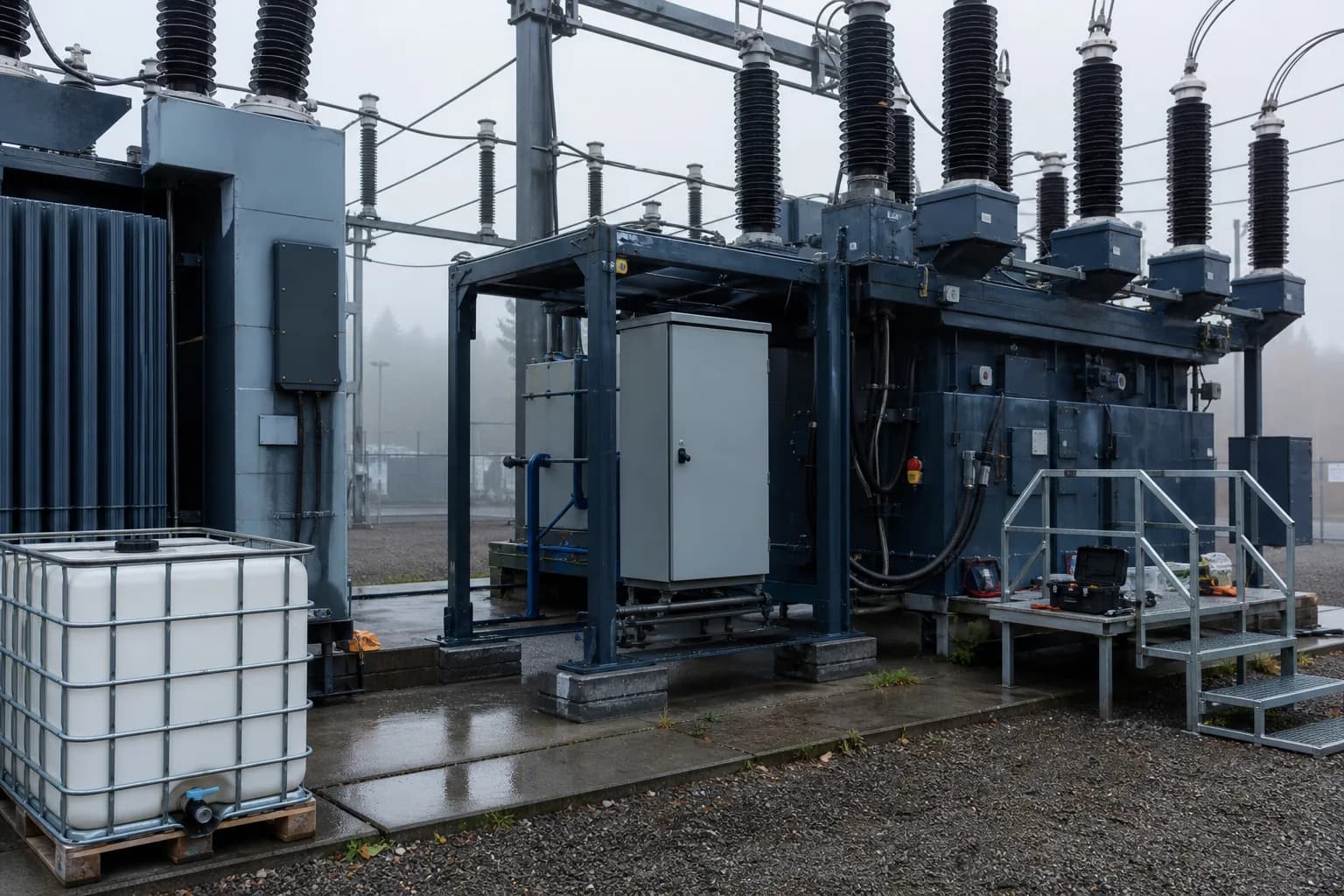
The anticorrosion formulation protects tower fasteners, cabinet hinges and earthing connections from atmospheric attack between inspection cycles.
Wind O&M crews treat slip-ring assemblies, pitch-drive connectors and tower-base cabinets on the same climb as inspection; solar teams protect combiner boxes and tracker drives where coastal and agricultural sites accelerate corrosion. Substation maintenance uses the dielectric film on busbar supports, disconnect mechanisms and control wiring against condensation cycling, with insulation-resistance readings before and after as the acceptance evidence. Because the fluid is re-enterable and non-curing, scheduled switching and service work proceed normally after treatment. Utilities standardise on twelve-month re-treatment cycles and consume by the tote across generation, transmission and distribution assets.
Backup-power fleets — generator terminals, transfer switches, battery rooms — round out the consumption profile: assets that must work on the worst day of the year are precisely the ones condensation degrades silently between tests, and precisely where a before/after megohmmeter reading makes protection auditable for both the reliability engineer and the insurer reviewing the maintenance regime. Asset-management teams fold the readings into their reliability-centred maintenance model, where a measured insulation trend beats a calendar assumption: the cabinets that drift get shorter intervals, the stable ones get longer, and the tote is consumed where it actually buys availability.
✓Switchgear and busbar moisture protection
✓Outdoor termination and disconnector treatment
✓LV cabinet condensation defence
✓Tower fastener and earthing corrosion protection