Loading...
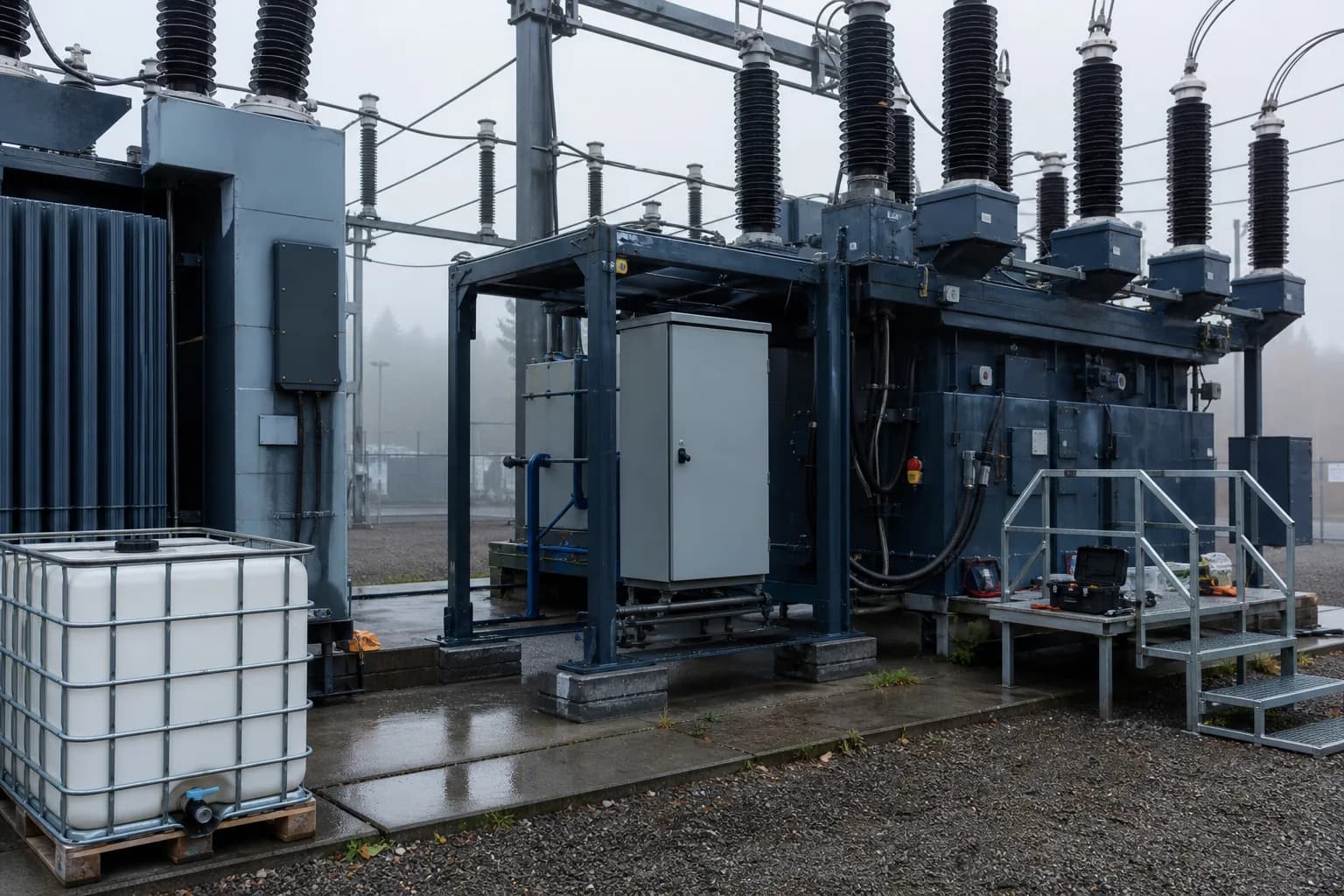
Key takeaways
- Condensation forms a weakly conductive film that trips RCDs and corrupts low-voltage signals — then evaporates before the technician arrives
- Insulation-resistance readings at dawn vs afternoon turn 'random' faults into a documented moisture problem
- Cabinet heaters and desiccants fight the symptom; a dielectric displacement film removes the conductive path itself
- Treatment works in place — no disassembly — and recovery is measurable within minutes
- A twelve-month re-treatment cycle moves the whole asset class from reactive to scheduled
The failure that leaves no evidence
An intermittent electrical fault is maintenance hell: the equipment fails at 6 a.m., works by the time the technician arrives, and the fault log says nothing useful. A large share of these ghosts follow one pattern — they happen after cool, humid nights, in autumn and spring, in coastal or washdown environments. That pattern has a name: condensation.
How a water film becomes a fault
When warm humid air meets a cold surface inside a cabinet or connector, water condenses as an invisible film. On insulator surfaces the film is weakly conductive — enough for leakage currents that trip RCDs and corrupt low-voltage signals. On contact metals it starts electrochemical oxidation, which raises contact resistance and generates heat, accelerating the oxidation further. By mid-morning the film has evaporated, the fault is gone, and the log shows a "random" event.
Why the usual fixes underperform
Cabinet heaters fight condensation with energy costs and only where the heat reaches. Desiccant packs saturate. IP-rated enclosures help until a gland ages or a door gasket compresses. None of them protect the one place faults actually start: the metal and insulator surfaces themselves.
Surface treatment: attacking the film directly
A dielectric protection film applied to contacts, terminals, busbars and connector bodies changes the physics. The formulation wets metal better than water, so condensation can't form a continuous conductive film — it beads on top of an insulating layer. Existing moisture is displaced; oxidation stops; insulation resistance recovers severalfold on already-degraded equipment, typically without disassembly.
Treated equipment rides through the humidity cycles that used to produce the 6 a.m. ghosts. The treatment renews on the maintenance calendar — before autumn for outdoor plant, on the standard rotation for coastal sites.
Scaling the countermeasure
One can treats one cabinet. Programs — every outdoor termination, every coastal site, every production line connector — consume litres, which is why utilities and OEMs buy dielectric formulation in drums and IBC totes. That is the supply we provide, with published composition, from the EU to anywhere.
What "dielectric" actually means on a spec sheet
Buyers searching for the dielectric meaning get dictionary answers; engineers need the operational one. A dielectric material resists the passage of current — its quality is expressed as dielectric strength, the voltage gradient it withstands before breakdown, measured in kV per gap under ASTM D877 or IEC 60156. A dielectric lubricant adds three behaviours the raw definition misses: it displaces water from energised surfaces, it stays put across the service temperature range without curing, and it remains re-enterable — a technician can open the connection, service it, and re-treat. That combination, not the dictionary property, is what returns leakage-tripped equipment to service.
Insulation resistance: the measurement that ends the guessing
An intermittent fault becomes a data point the moment you put a megohmmeter on it. Measure insulation resistance at the cabinet's dawn low-point and again mid-afternoon: a tenfold swing tracks the condensation cycle and names the culprit no fault log can. After treatment with a moisture-displacing dielectric film, the same measurement shows recovery — typically severalfold within minutes, as the fluid lifts the water film off insulator surfaces. Keep the before/after numbers; they are the acceptance evidence your maintenance system wants, and they turn a mystery reliability problem into a documented, closed work order.
Terminals, threads and the copper anti seize question
Electrical maintenance carts usually carry a copper anti seize paste for battery terminals and grounding bolts. It solves galling, but conductive copper-loaded pastes near live circuitry create their own leakage risk, and they do nothing for moisture. On terminals whose real enemy is condensation, a dielectric film does both jobs: the treated thread still torques and releases cleanly, and the joint gains a moisture barrier instead of a conductive smear. Reserve true anti-seize compounds for the mechanical bolt inventory; keep the electrical inventory on dielectric protection — and stop the corrosion-seized-terminal write-offs both ways.
Building the condensation-proof maintenance loop
The pattern that works at plant scale: identify the assets that fail after humid nights — outdoor cabinets, pit-mounted sensors, coastal switchrooms. Treat every non-arcing contact surface, busbar support and connector shell with the dielectric film during a scheduled outage. Log insulation resistance before and after. Then move the assets from reactive to a twelve-month re-treatment cycle. Plants that run this loop report the 'random' dawn trips simply stopping — because the film denies condensation its conductive path, every night, without a heater's energy bill or a desiccant's saturation curve.
The failure ledger: what dawn trips actually cost
Price the ghost faults honestly and the treatment decision makes itself. A single nuisance RCD trip on a production line costs the restart time of everything downstream — for food, pharma or continuous-process plants, that is hours, not minutes. An intermittent sensor fault earns two technician visits before anyone suspects moisture: one to find nothing, one to swap a healthy part. Multiply by every outdoor cabinet and every humid season, and most plants discover a five-figure annual spend hiding inside 'no fault found' work orders. Against that ledger, treating a cabinet costs minutes of an outage window and grams of formulation. The asset-management argument is even simpler: moisture-driven leakage is progressive — every humid night advances electrochemical attack on contacts — so the film is not just stopping trips, it is arresting the corrosion clock on equipment you would otherwise replace early.
Two questions maintenance teams ask first
Can the film be applied to live equipment? Treatment is applied to isolated equipment; once the film is in place, the assembly returns to service and the protection works continuously under power. The fluid is non-curing and re-enterable, so future service work proceeds normally — open, service, re-treat the disturbed surfaces.
Does the treatment interfere with contact function? No — that is the defining engineering property. On separable contacts the film is displaced at the contact points under normal contact pressure while continuing to seal the surrounding surfaces against moisture. Relays, connectors and terminals operate normally; what disappears is the leakage path across humid insulator surfaces.
Case pattern: the coastal pump station
A typical sequence from the field: a coastal water utility logs intermittent RCD trips across three pump stations every autumn, each trip a call-out, each inspection finding nothing. Thermal cameras show nothing; contact resistance measures fine by afternoon. The pattern only surfaces when someone plots trip timestamps against dew-point data — the correlation is immediate. The fix took one maintenance window per station: isolate, treat every terminal strip, connector shell and busbar support with the dielectric film, log insulation resistance before and after, return to service. Recovery measured fourfold to tenfold per cabinet. The following autumn: zero weather-correlated trips across all three stations, and the utility moved its remaining outdoor cabinets onto the same twelve-month treatment cycle. The economics are lopsided — grams of formulation and minutes of labour against years of call-outs that closed 'no fault found'.
Terms worth knowing before you measure
Insulation resistance (IR): the resistance between a conductor and earth, measured with a megohmmeter at test voltage — the single number that quantifies moisture degradation. Leakage current: the small current crossing a humid insulator surface; enough to trip an RCD long before anything is visibly wet. Tracking: progressive carbonised paths across contaminated insulator surfaces — the end stage the film prevents. Dielectric strength: the voltage gradient a material withstands before breakdown (≥45 kV per ASTM D877 for our formulation). Log IR before and after treatment on your first trial cabinet; that pair of numbers is the entire business case in two data points.
One closing habit multiplies everything above: put the megohmmeter reading into the work order every time, treated or not. Within a year the maintenance system holds a moisture map of the whole site — which cabinets drift, which hold, which environments punish equipment fastest — and the treatment calendar starts writing itself from your own data instead of anyone's recommendation, ours included.
Where to next
FAQ
Why does moisture cause most electrical failures?+
Condensation forms conductive paths across insulators and connector faces; leakage currents grow until insulation resistance collapses. Roughly 80% of equipment failures trace back to moisture damage.
Can a dielectric fluid restore already-damaged equipment?+
Often, yes. The formulation displaces moisture from windings and contacts and insulation resistance recovers — field trials measured recoveries from hundreds of kilohms to gigaohm levels within days, without disassembly.
Is the dielectric formulation safe on plastics and rubber?+
Yes. It is silicone-, PTFE- and solvent-free and harmless to metals, plastics, rubber, glass, ceramics and motor windings — it can be applied to energised-adjacent assemblies after de-energising.
Where to next
PROCUREMENT
The Real Cost of Buying Corrosion Protection in Aerosol Cans
A fleet workshop treating 400 vehicles a year pays for packaging, propellant and retail ma…
PROCUREMENT
How to Read a Corrosion Inhibitor Spec Sheet
Base oil, additive fraction, salt-spray hours, film type. What the numbers on a corrosion …
ENGINEERING
Salt, Humidity and Steel: Why Coastal Assets Corrode Faster
Chloride ions and constant moisture turn ordinary corrosion into an accelerated attack. Wh…
Ready for tote scale?
Lab samples ship within a week — sealed bottle, CoA and test protocols included.