Loading...
Key takeaways
- Chlorides make the surface water film conductive — coastal corrosion runs several times faster and pits deeper
- Mixed-metal assemblies add galvanic attack; the salt film closes the cell circuit around the clock
- Stainless is not immune: chloride pitting defeats passive layers at the coast
- A displacement film breaks both the chloride film and the galvanic path in one application
- A wash–treat–inspect calendar beats any single heroic coating
Why salt changes everything
Corrosion needs metal, oxygen and water. Salt adds a fourth accelerant: chloride ions. Dissolved in the thin water film that coats every surface near the sea, chlorides make that film conductive, speeding the electrochemical reaction and breaking down the passive oxide layer that would otherwise slow it. The result is corrosion that runs several times faster than inland, and pitting that drives deep instead of spreading thin.
The coastal moisture cycle
Coastal air rarely dries out. Overnight condensation, salt spray and high humidity keep a conductive film on metal almost continuously. Painted surfaces fail at every chip and edge, and once chloride gets under the paint it spreads unseen. Bolts, terminals, hinges and fasteners — the parts paint never covers well — seize and fail first.
Why a displacement film wins at the coast
A moisture-displacing anticorrosion film addresses the coastal problem directly: it pushes the salt-laden water off the metal, seals the surface against re-wetting and stays elastic through the daily humidity cycle. Because it flows, it protects the edges, threads and crevices where salt attack starts. Reapplied on a sensible schedule, it keeps marine and coastal steel serviceable far longer than a barrier coating alone.
Where it earns its place
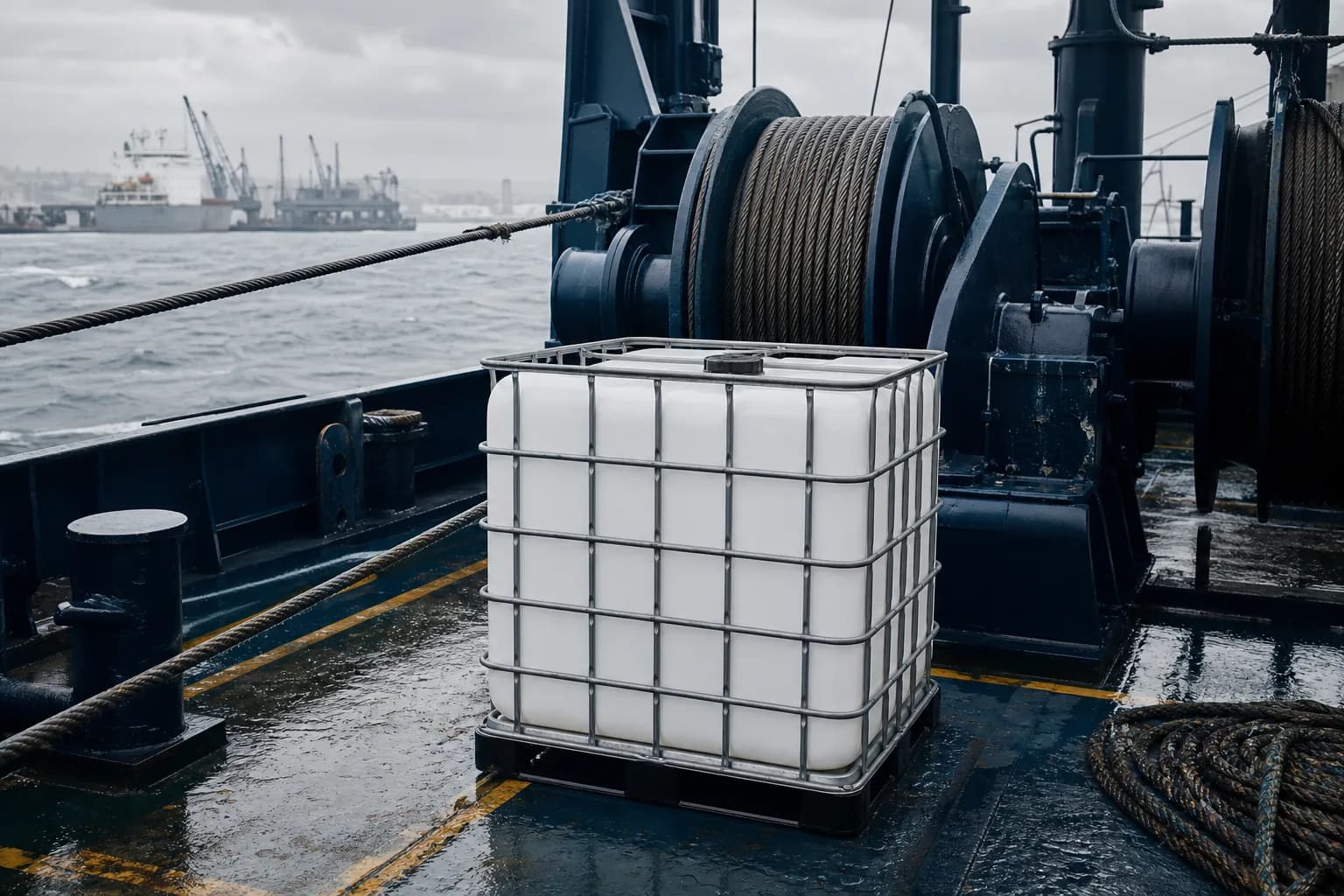
Harbour equipment, vessel fittings, coastal solar and wind hardware, dockside machinery, trailer and vehicle underbodies exposed to road salt — anywhere chloride meets steel. Operations at this scale consume protection by the litre and buy the formulation as bulk raw material in IBC totes, applied by spray or fogging across large surface areas.
Galvanic corrosion: the coastal multiplier nobody budgets for
Salt water is an electrolyte, and coastal assemblies are rarely one metal. Wherever a stainless fastener meets an aluminium bracket, or a copper earth strap lands on galvanised steel, the pair forms a cell — and galvanic corrosion begins eating the less noble metal. Inland, the effect is slow because the circuit needs moisture to close. At the coast, the conductive salt film closes it around the clock. This is why aluminum corrosion around stainless bolts is the signature failure of seaside solar mounts, antenna masts and deck hardware: the aluminium sacrifices itself to protect the steel, white oxide blooms around every fastener, and torque values quietly disappear.
Galvanic corrosion prevention at design time means isolating dissimilar metals — sleeves, washers, barrier coatings. On equipment already in the field, the practical fix is the same displacement film that handles chloride attack: it breaks the electrolyte path. No continuous salt film, no cell current. A treated joint behaves like an inland joint, even ten metres from the surf.
Reading a galvanic corrosion chart before you specify
A galvanic series chart ranks metals by electrode potential in seawater — magnesium and zinc at the active end, titanium and graphite at the noble end. Two rules of thumb make it useful without a electrochemistry degree. First, the further apart two metals sit on the chart, the faster the active one corrodes; stainless-against-aluminium is a wide, aggressive pair, while aluminium-against-zinc is close and mild. Second, area ratio decides severity: a small active-metal part against a large noble surface — an aluminium rivet in a stainless panel — fails fast, while the reverse pairing survives. Stainless steel corrosion resistance itself depends on that thin passive chromium-oxide layer; once chlorides pit through it, stainless can corrode enthusiastically, which surprises buyers who specified it as the 'no-maintenance' option.
Pitting: why coastal damage runs deep, not wide
Uniform rust announces itself; pitting corrosion does not. Chlorides attack the weakest point of a passive layer and drill a narrow, self-accelerating cavity — the pit bottom turns acidic and anodic while the surrounding surface stays cathodic and clean-looking. A panel can pass a visual inspection with 90% of its surface intact while a single pit has already penetrated half the wall thickness. This is the failure mode that sinks coastal fastener inventories and cracks hydraulic lines. Because pitting needs a stagnant chloride-bearing film to start, the countermeasure is the same as for the general attack: displace the film, seal the surface, re-treat on schedule. A rust inhibitor film that stays elastic — rather than a hard coating that cracks at the first stone chip — denies pits their starting point.
A coastal maintenance calendar that actually works
Field crews standardise on a simple loop. Baseline: wash salt deposits off, dry, apply the anticorrosion film to every unpainted surface — fasteners, hinges, terminals, rod ends, cut edges. Quarterly: visual check of high-splash zones; re-treat anything that shows film thinning. Annually: full re-application before the storm season, plus dielectric treatment of every junction box and connector the salt air reaches. Operations that run this calendar report corrosion write-offs falling to a fraction of their previous rate — not because any single application is heroic, but because the film never gets a season off.
Specifying for coastal service: what to write into the contract
Facilities teams inherit corrosion problems that procurement created. If the asset will live within a few kilometres of salt water, write the exposure into the specification: require corrosion-protection provisions for unpainted surfaces, dissimilar-metal isolation at every stainless-to-aluminium interface, and a named re-treatment interval in the maintenance schedule rather than a vague 'as required'. Demand salt-spray-backed data for whatever protective film the contractor proposes, and retain the right to substitute an equivalent with better documented numbers. On the operations side, budget the treatment consumable per asset per year — at bulk pricing it is a rounding error against one seized crane bearing or one replaced junction box. The pattern across harbours, coastal solar farms and seaside plants repeats: the sites that specify protection up front spend on litres; the sites that do not, spend on replacements.
Two questions coastal operators ask
How close to the sea does 'coastal' begin? Airborne chloride deposition is measurable kilometres inland, with sharp gradients in the first five hundred metres. The practical test is your own hardware: if fasteners show white aluminium oxide or early red rust within a season, your site is coastal regardless of the map. Specify protection accordingly.
Is a displacement film compatible with painted structures? Yes — the film is applied over intact paint at edges, chips and fastener penetrations, exactly where coatings fail first. It is neutral to cured paints and lacquers, and it seals the chip-to-substrate interface where chloride creep starts undercutting the coating.
The inventory walk: finding your chloride exposure before it finds you
The highest-return hour a coastal facilities manager can spend is a walk with a notebook. List every unpainted metal surface within salt reach: fastener heads, hinge pins, valve stems, cable trays, junction-box glands, guard-rail bases, the cut edges where galvanising stops. Note every dissimilar-metal pair — stainless on aluminium, copper on steel — because those joints corrode first and seize hardest. Then rank by consequence: which seized fastener stops production, which pitted line carries pressure, which corroded gland lets water into a live cabinet. That ranked list is the treatment program; most sites find the critical inventory is a few hundred discrete points that one technician treats in a day or two per round. The alternative — waiting for the maintenance backlog to surface the same list as failures — costs more every season and always surfaces the worst item at the worst time.
Terms coastal maintenance teams use
Chloride deposition rate: the mass of airborne salt settling per square metre per day — the objective measure of how coastal your site is. Passive layer: the self-forming oxide film that protects stainless and aluminium until chlorides pit through it. Galvanic series: the ranking of metals by electrode potential in seawater that predicts which metal in a pair sacrifices itself. Displacement film: chemistry that pushes the water layer off metal before sealing it — the property that separates true protection from products that merely coat over trapped moisture. Scribe test: scoring a treated panel to verify protection at damage sites, where coastal corrosion actually starts.
Where to next
FAQ
How much faster do coastal assets corrode?+
Salt-laden air accelerates corrosion by an order of magnitude versus inland exposure — chloride deposits keep metal surfaces conductive and wet far longer after each humidity cycle.
Does the anticorrosion formulation handle salt water directly?+
Yes. It displaces all forms of moisture including salt water, acid rain and chloride-laden spray, and holds protection in electrolyte immersion — an accredited test ran 8 months in electrolyte without corrosion on carbon steel.
How often should coastal equipment be re-treated?+
The barrier film is rated for roughly 12 months per application in continuous outdoor exposure; harsh splash-zone assets are typically re-treated on the annual maintenance cycle.
Where to next
PROCUREMENT
The Real Cost of Buying Corrosion Protection in Aerosol Cans
A fleet workshop treating 400 vehicles a year pays for packaging, propellant and retail ma…
ENGINEERING
Why Humidity Is Behind Most "Random" Electrical Failures
Intermittent faults, morning trips, connectors that fail only in autumn — the pattern behi…
PROCUREMENT
How to Read a Corrosion Inhibitor Spec Sheet
Base oil, additive fraction, salt-spray hours, film type. What the numbers on a corrosion …
Ready for tote scale?
Lab samples ship within a week — sealed bottle, CoA and test protocols included.